An enterprise AI transformation roadmap connects business strategy to changes in the way the enterprise works. I use this AMASE Master Plan to bring leadership, enterprise architecture, engineering and governance into the same conversation. The question I start with: which business capability do we want to improve, and what needs to change for that improvement to last?

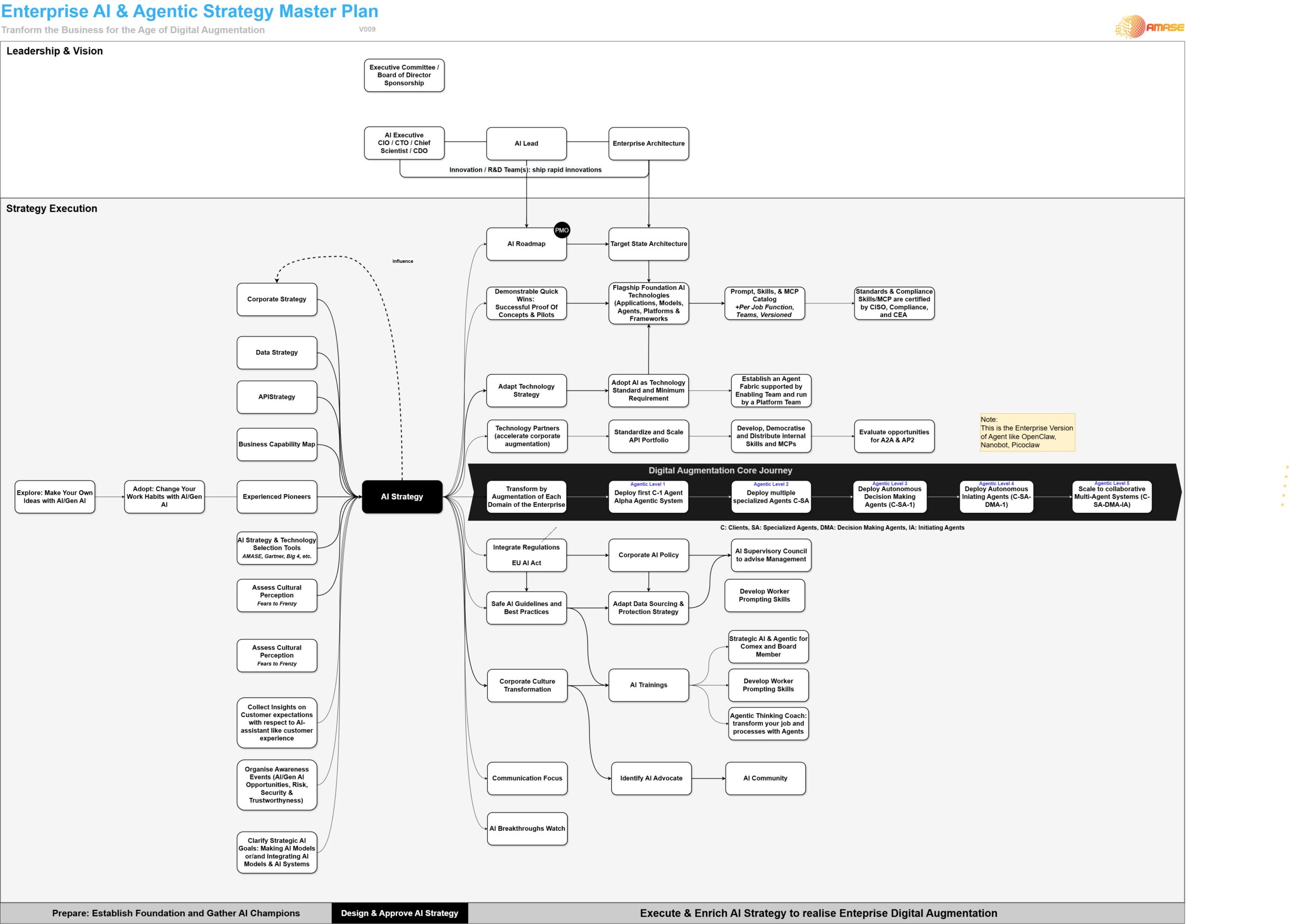
How I build an enterprise AI transformation roadmap
- Agree on the direction. Start with corporate strategy, customer needs and a business capability you want to change. Name an executive sponsor and the person who will own the outcome.
- Map the work and its dependencies. Look at how people make decisions, which data and systems they rely on, and where APIs, controls or skills are missing. Use that map to define the target architecture and sequence the work.
- Test one workflow end to end. Give the pilot a real owner, a baseline and a clear decision at the end. Check whether it helps people do the work, how it handles exceptions, and what it costs to operate.
- Scale the parts that earn their place. Share the capabilities teams can reuse, such as integrations, skills and MCP servers. Move from individual augmentation to specialized agents and, when the workflow warrants it, to agents that coordinate with each other.
- Keep governance close to the work. Assign ownership for data protection, access, human review and incident handling. Train the people who use and operate the system, and use their feedback to revise the architecture and the roadmap.
What I learned leading AI adoption in banking
It took us a year to lay the foundations of the transformation. From the Technology Office, we aligned Enterprise Architecture, Engineering and Innovation. We also built support internally and engaged with the local tech ecosystem. That experience shaped the way I approach the roadmap: design the conditions under which teams can deliver and take ownership of the change. Read the account in The Human Moat.
Take the example of a credit team that must read a file, find the relevant policy and prepare a recommendation. I would start with an assistant that gathers the evidence and points to its sources. The credit team keeps the decision. Before expanding the pilot, I would compare time per file, corrections required, evidence traceability and data access exceptions against the starting point. This is an example of applying the plan, with measures to test in the pilot.
Where to start
Pick one workflow where you can speak to the people who do the work. Trace it from the first request to the final decision. Then use the diagram to see what must be built once for the enterprise and what should stay with the team that owns the work.
Browse the architecture resources · Read the Generative AI series · Talks and interviews