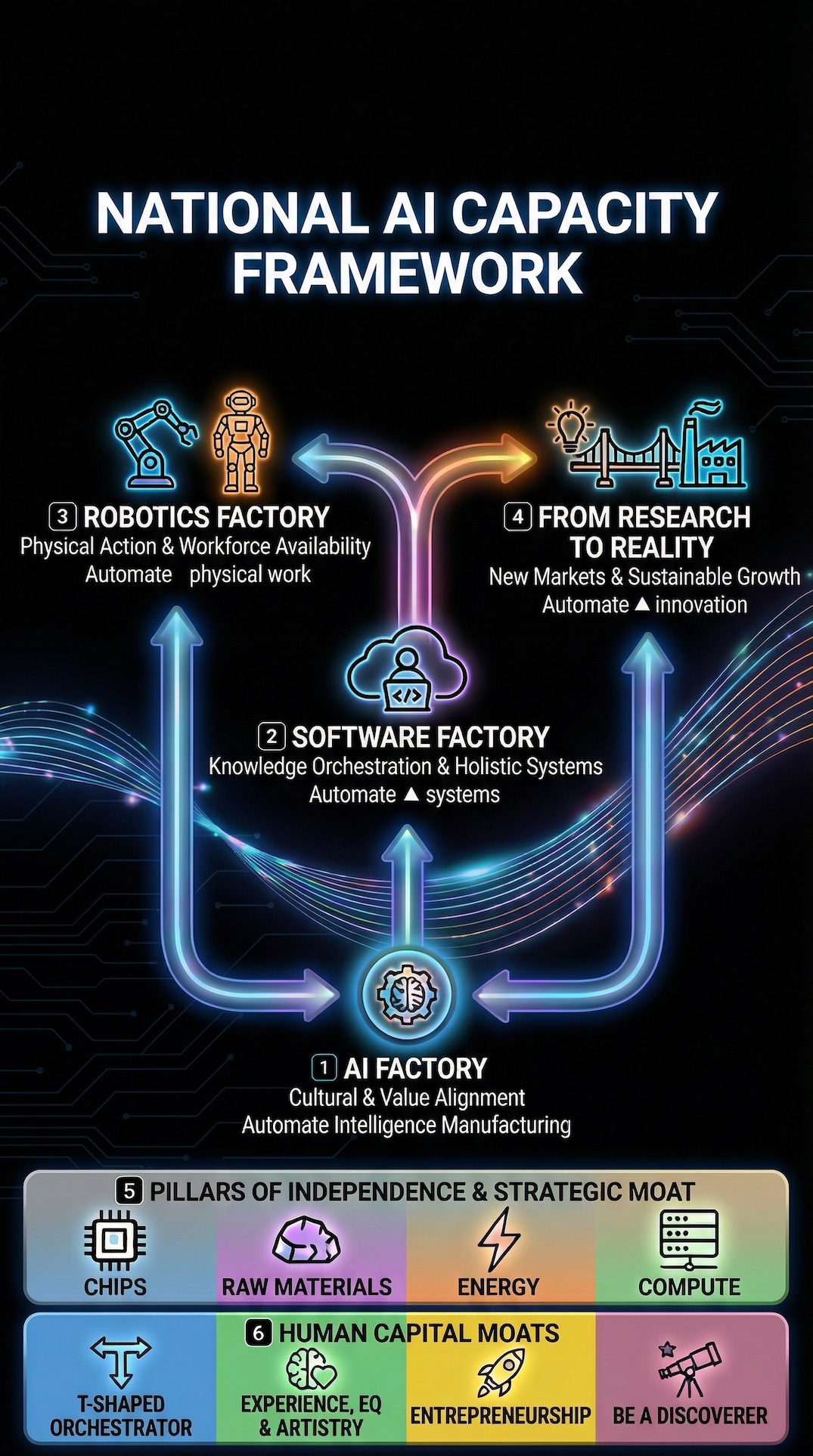
From now on, it’s becoming undeniable: for any country to thrive and sustain itself over the next 100 years, it must create a Sovereign AI Capacity stack.
Project-level AI ROI? Too little. Too narrow.
Because this is no longer just about productivity. It’s about strategic autonomy: owning the critical dependencies of intelligence, software generation, and the automation that moves the physical world.
Here is the strategic framework for this new reality:
1 – The AI Factory
It is not enough to simply access foreign intelligence; a nation must possess the capacity to establish its own AI models.
This means either training models entirely from sovereign data collections or fine-tuning existing foundation models (LLMs). The critical objective here is cultural and value alignment. We must ensure, by design, that the AI guarantees the continuity of the sovereign Nation. The models must reflect the nation’s DNA, not an imported worldview.
2 – The Software Factory
Powered by the AI Factory, this is arguably the most essential component. It ensures scalability and coherence across the nation’s infrastructure, but above all, it enables the liberation of human intelligence through creativity.
This factory integrates human intelligence to build national-level systems of systems—created for people, by people. It achieves resilience and high independence without sacrificing the necessary interdependence with other nations.
After all, we are One humankind.
3 – The Sovereign Robotics Factory
Software is the mind; robotics is the hand. Sustainable growth requires continuous workforce availability. Robotics is the pivotal technology that enables the dynamic reallocation of the workforce based on real-time market demands.
Crucially, it ensures that minimum resilience targets in critical industries (like Healthcare or Hotel/Restaurant/Cafe) can be met regardless of labor fluctuations or demographic shifts.
4 – From Research to Reality
The winning nations are those that can rapidly translate research and development (R&D) advancements into practical applications.
Bridging the gap between theoretical breakthrough and industrial application is the only path to reaching Sustainable Abundance.
5 – The Pillars of Independence & The Strategic Moat
To sustain this ecosystem, nations must secure critical inputs: Chips, Raw Materials, Energy, and Compute (Cloud).
Obviously, trade remains necessary. No nation is an island. However, national strategies must be designed to establish a sustainable moat within the open market.
It is likely that some countries currently lack the capacity to spin up research programs immediately. Building this pipeline takes years of strategic planning. The alternative is to source research through trusted partnerships or to ruthlessly narrow down fields of research to niche specializations.
But let’s be clear: one nation should never bargain with its future. Innovation is not an option; it is a necessity.
In this new landscape, expertise, specialization, and care are king.