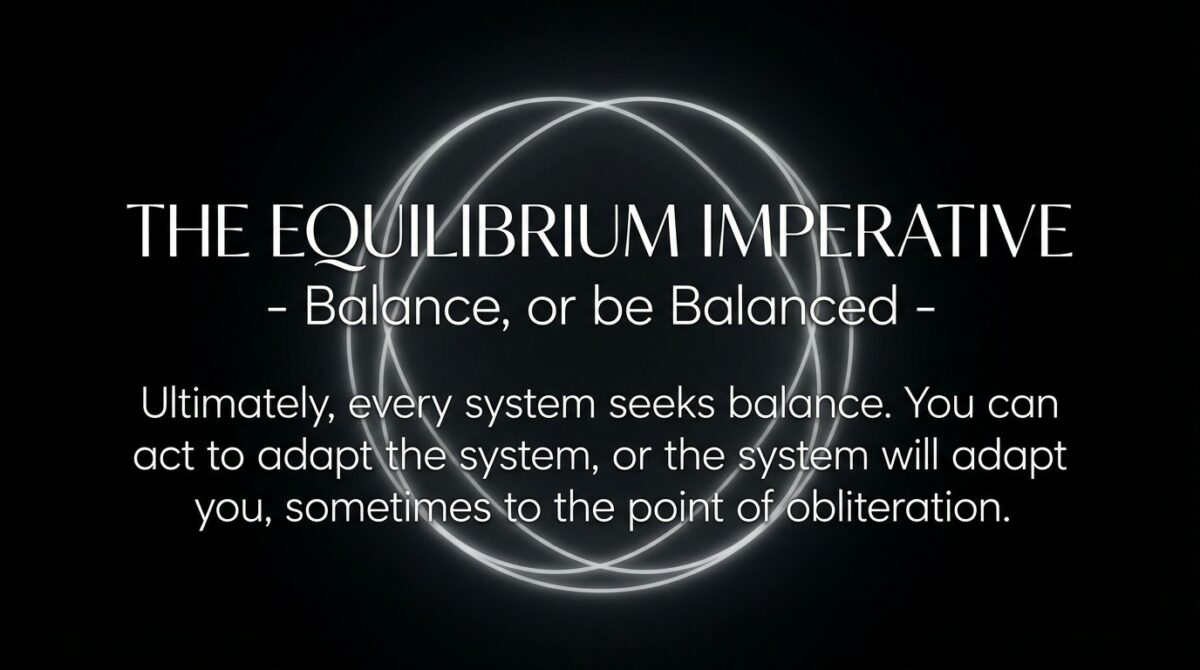
Either you shape the balance, or the balance shapes you.
Yannick HUCHARD
Have you ever waited too long and missed your chance? Stayed silent in a meeting when you knew you should have spoken up? Watched someone seeming less capable, but with more drive, get the opportunities you thought you deserved?
There is a reason this happens. It isn’t bad luck, and it isn’t fate. It is a hidden law that governs our lives, our careers, and our global systems.
I call it the Law of the Equilibrium Imperative.
The rule is shocking in its simplicity and terrifying in its consistency: Life always seeks balance. If you don’t create the balance you want, life will create one for you.
It is a fundamental law of reality that progressively came to attention in the form consistently repetitive pattern. In physics, imbalance becomes motion until forces neutralize. In biology, imbalance becomes evolution until life re-stabilizes. In economics, imbalance becomes market correction.
You are always in one of two states: you are either actively balancing your system, or you are passively being balanced by it.
Understanding this is the difference between being a victim of circumstance and an architect of reality.
1. The Mechanism: Why the System Moves
The Equilibrium Imperative dictates that no system, whether a single human psyche or a multinational corporation, can remain in a state of tension forever.
Nature hates a vacuum. An unspoken desire, a neglected problem, or an unacted-upon idea is an unstable void. It is an “imbalance” in the fabric of reality.
The system must resolve this tension.
- If you do not fill the void with action, someone else will fill it with their action.
- If you do not resolve the tension with a solution, the system will resolve it with a collapse.
Inaction is not “pausing the game.” Inaction is surrender. It is an invitation for the forces of entropy to decide your fate.
2. The Evidence: How the Law Manifests
Let’s look at how this plays out across the three dimensions of human experience: The Career, The Craft, and The Heart.
The Silent Meeting: The High Cost of Peace
You’re in a meeting. A terrible idea is gaining momentum. Your gut screams “Mistake!” but speaking up means conflict. So, you stay silent.
What you’ve created in that moment is a gap between the group’s delusion and the reality you see: an imbalance hanging in the air like a held breath. The system cannot sustain this tension indefinitely. Months later, when the project proceeds and fails for the exact reason you predicted, the correction arrives with brutal efficiency. The company has been “balanced” by failure, and you’ve paid the price for your silence.
Choosing short-term comfort over long-term integrity is like taking out a high-interest loan. You get a moment of peace, but the bill always comes due.
The Daily 1%: Why Hard Work Beats Talent
In competitive fields, many have “talent.” They rely on bursts of inspiration. But the winner is often the person who commits to the daily 1%—the extra 5 minutes, the boring repetition.
Here, the imbalance exists between the resistance of the task and the force of your will. When you apply consistent pressure, you become the corrective force that shapes the equilibrium. Water carving a canyon is a slow, gentle force, but it is relentless. Those who rely on raw talent without the weight of effort are eventually balanced out of the running by those who understand the physics of persistence.
In competitive fields, many have “talent.” They rely on bursts of inspiration. But the winner is often the person who commits to the daily 1%—the extra 5 minutes, the boring repetition.
The harder I prepare, the luckier I seem to get
Michael Jordan
The Open Door: Love and Missed Shots
You feel a spark. A connection. Or perhaps you have a brilliant business idea. But you wait for the “perfect moment.” You hesitate. You tell yourself, “There’s still time.”
The tension builds between your internal desire and your external inaction, creating an unstable equilibrium that demands resolution. The world doesn’t wait. Someone braver asks that person out. A competitor launches that business. The open door slams shut. The system found its balance without you, and in your hesitation, you gave away your power to the most decisive force in the room.
3. The Two Paths: Adapt or Be Adapted
Within any system, you face a binary choice. There is no third option.
- Proactive Adaptation (Agency): You sense emerging tensions. You speak up, you act, you pivot, you ask for help. You guide the equilibrium toward your purpose.
- Reactive Adaptation (Submission): You resist the change or ignore the signals. The system enforces equilibrium upon you through disruption, obsolescence, or crisis.
This is why organizations that ignore signals of change don’t just fall behind; they become the raw material of the system’s next balance.
4. The Leader’s Responsibility
To lead within this law is to sense imbalance early and shape its resolution intentionally. A wise leader (of a company or a family) does not fear the imbalance. They use it.
- Detect feedback loops before they scream.
- Anticipate external pressures before they rupture the system.
- Use adaptation as a creative force, not a defensive act.
Innovation is just the proactive balancing of a market inefficiency. Governance is just the proactive balancing of human behavior.
Asking for help is not a sign of weakness; it shows awareness, and it is a deliberate operational strategy. It is acknowledging an imbalance (I cannot do this alone) and leveraging resources to restore it (collaboration).
5. How to Apply the Law
You can guess: it is all about the process.
- Sense the imbalance: Observe the patterns of tension in your life. Where are you waiting? Where are you staying silent? Where is there friction?
- Interpret the signals, sort the noise: Ask what forces are seeking equilibrium. What is the system trying to tell you? Is the market shifting? Is the relationship drifting?
- Act with calculated effects: Take measured, adaptive action to guide the balance. Make the call. Send the email. Kill the project.
- Reflect to build equilibrium wisdom: Every intervention generates new imbalances. The work of equilibrium is perpetual. Your job is not to stop the motion, but to conduct it.
This basic 4-step thinking kata is to be learned and repeated until it becomes a reflex. Mastery begins with a single skill: your ability to sense imbalance and step back, observing the pattern as a solid mental object you can examine from all angles.
The Final Choice
The Equilibrium Imperative carries a principle meant to empower you, continuously, permanently. It hands you the controls.
- Inaction is a choice. It is the choice to let the world decide.
- Agency is your power. It is the choice to decide for the world.
Humanity itself is a system suspended between chaos and order. We either redesign our relationship with our technology, our ecology, and each other, or these systems will redesign us through crisis.
The law remains immutable:
The system will balance itself. Those who adapt, thrive. Those who resist, are adapted.
So, I leave you with one simple, life-altering question:
Will you create the balance you want, or will you let life create one for you?
Yannick HUCHARD