Categories
Agents Artificial Intelligence Automation Businesses Information Technology Strategy Technology

SaaS is Being Disrupted: 6 AI Shifts That Will Redefine Your Business (Which Will Hit You First?)

Based on my analysis of current AI developments worldwide, here are six trends I anticipate emerging over the next 6-18 months (the pace of evolution is extraordinary).

1) Applications with Dynamic User Interface

AI models will adapt user interfaces to match specific work environments, individual worker roles, and personal preferences.

This represents a fundamental disruption to traditional SaaS, driven by the rapid development capabilities of coding agents and AI systems’ ability to integrate data through standardized interoperable interfaces (API and MCP).

Note: The building blocks already exist.

2) Personal AI Assistant in a Box

We’ll soon see laptops and mini computers (Mac Mini, Raspberry Pi, Mini PCs) pre-configured with local AI agents.

Cloud-based offerings from hyperscalers will follow the same pattern.

3) Specialized Workforce as a Service

Specialized AI workers with domain-specific skills will be available on-demand to excel at particular tasks within given cultural and regulatory environments.

This represents the evolution of SaaS in the coming disruption.

For example, you would expect Salesforce to launch a full-fledge Sales Agent Worker as a Service (Agentforce is the first iteration).

Signals: Claude Cowork with plugins (such as Legal), released recently, and OpenAI’s Frontier, just announced, are clear steps in this direction.

4) Enforced Agent Identity

We’re moving toward a world of 9 billion people and potentially 90 billion agents.

We’ll need to establish ownership and representation for each agent to manage critical flows—particularly financial transactions (banks should prepare for autonomous personal AI agents conducting banking operations) and legal representation for actions and decisions.

Think Security, Security, and Security.

5) Front-End APIs (App-to-App APIs)

Applications running on front-ends and mobile devices will require APIs to integrate and communicate securely within trusted environments on smartphones, laptops, and other devices, with compute happening at the edge only.

This shift is supported by the rebalancing we’re witnessing: while centralized cloud data centers continue to grow, we’re simultaneously seeing more powerful smartphones and laptops equipped with GPU AI computing capabilities (like Apple’s M series).

6) Portable Context Database

Your context is essential for a genuine agent experience. If you haven’t tried ChatGPT with memory activated, you’re missing the true potential of AI assistance-and this is just a preview.

Letta AI and OpenClaw (previously known as Clawdbot) offer long-term memory mechanisms, but these contexts remain constrained to specific AI technologies/ models. I anticipate a standard, enabling your context and credentials to flow seamlessly between Anthropic Claude, ChatGPT, Google Gemini, and Microsoft Copilot, with clear separation between:

  • Personal Private Context
  • Personal Group Context
  • Personal Public Context
  • Work Private Context
  • Work Corporate Context
  • Work Secret Context.

What This Means

These trends enable the development of robust business strategies, technology roadmaps, solutions, consulting services, and vertical startups.

Most importantly, they help protect your people during continuous and accelerating changes in how we work.

Whatever you’re planning, consider how it fits your business and think sovereign, whether that’s on-premise AI infrastructure (hello Mistral AI), regional data residency, or proprietary context databases; this is your competitive moat.

Meanwhile, major AI players are absorbing business value like black holes. Remember: regulatory frameworks may slow execution, but they also protect your business by limiting market penetration from external competitors.

Your most important assets are the business experiences you offer, your staff, and your data. AI is coming for everything in between.

Yannick HUCHARD
Categories
Agents Artificial Intelligence Businesses Information Technology Society Strategy Technology

AI’s Paradox: Tyler Cowen on Individual Empowerment, National Dependence & Exploring the New Economic Order

If you want another look at how the world is currently changing with the introduction of #GenerativeAI in our daily lives, and the national-level decisions for countries that may not build foundational #LLMs but are conscious that the future of #work, #education, #productivity, and research depends on AI, its cultural modeling, and the reliance on superpowers and mega-corporations/hyperscalers, this talk is worth watching.

This presentation by Tyler Cowen at George Mason University  offers some truly worldview-shifting insights that could directly impact you:

Your Skills vs. AI: Is “being the smartest person in the room” still your best asset, or is learning to guide AI now more valuable for your career?

  • Expert Help on Demand: What if you, or your local doctor, could instantly tap into top-tier specialist knowledge for complex problems, all through AI?
  • Your Job, Radically Changed, Soon: How will your day-to-day tasks and professional identity shift when AI starts handling significant parts of your current workload – potentially within the next 24 months?
  • Launching Big Ideas, Leaner Than Ever: Could you, or a small, agile team, realistically build and scale a major project or business that once required a large corporation, thanks to AI?

Tyler Cowen discusses #artificialintelligence from an economist perspective and its potential impact on various aspects of life and society. He highlights how AI is not just about knowledge recall but is outperforming humans in complex tasks and even nuanced interactions.

In this context, here is quote from the first episode Navigating the Future with Generative AI: Part  1, Digital Augmentation  of my series published in April 2023:

“It raises the responsibility of Managers and the Human Resources department in the whole equation. Colleagues require to be upskilled to stay ahead, not only for the sake of the company but also to help them to keep building their personal value with respect to the market. Thus, leaders and HR have to set things in motion by organizing the next steps, while their own jobs are being reshaped and augmented…”


Invest a few minutes of your life to make decisions, not just undergo them.

@YouTube [https://lnkd.in/eQWWPKUj]

Yannick HUCHARD

Categories
Artificial Intelligence Education Engineering Society Technology Wisdom

A.I. – What do we want and what we do not want

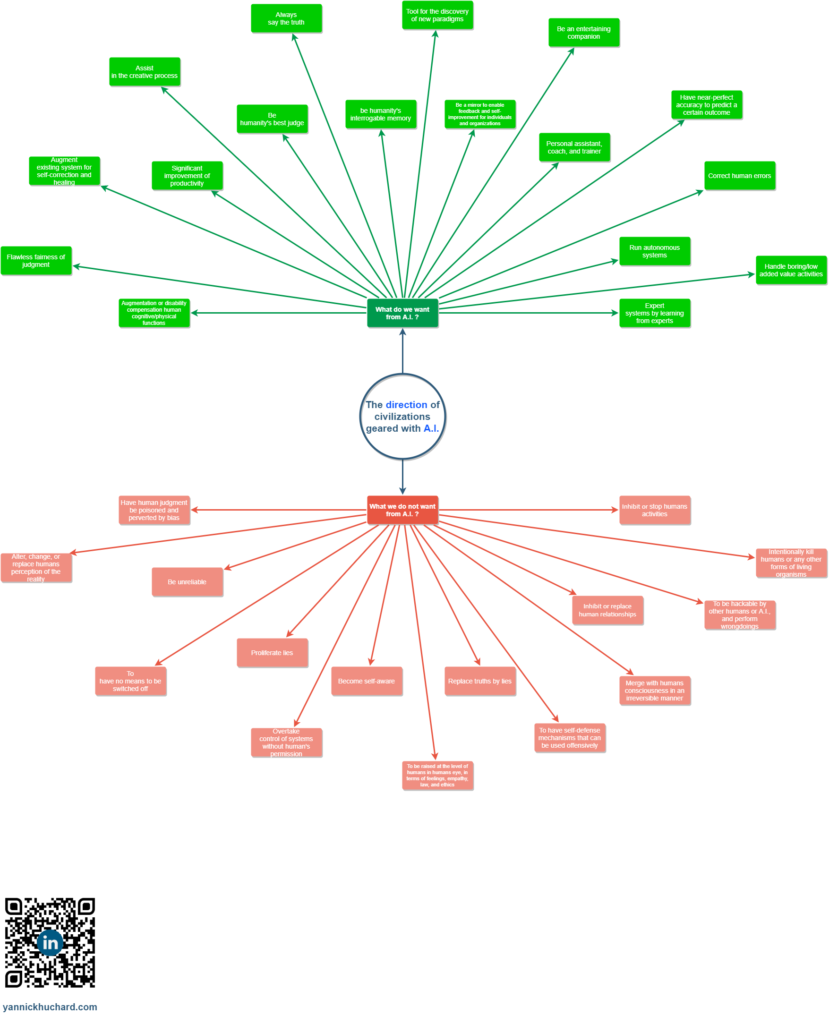
What do we want and do not want from A.I. V001

The Direction of Civilizations Geared with A.I.: A Comprehensive Exploration

(updated: 12/09/2025)

Artificial Intelligence (AI) is not just another technological advancement—it is a generational disruption, a force that is reshaping industries, economies, and societies at an unprecedented pace. As I’ve often said, AI is your new UI and your new colleague. But with this transformation comes a fundamental question: What kind of civilization do we want to build with AI?

The mind map I’ve created, “The Direction of Civilizations Geared with A.I.,” explores this question by dissecting both the aspirations and apprehensions surrounding AI. It’s a visual representation of the duality of AI’s impact—its potential to elevate humanity and its risks if left unchecked.

However, my perspective is not about rejecting automation or end-to-end systems like Gigafactories. I am not against automated systems or super-systems that operate seamlessly, as long as humanity retains the knowledge to sustainably modify, upgrade, or halt these supply chains. What I oppose is the loss of foundational knowledge—the blueprints, the ability to relearn, and the erosion of stable resilience in our societal and industrial systems.

What We Want from A.I.: The Green Path

1. AI as a Catalyst for Human Potential

  • AI as a Co-Pilot for Humanity: AI should augment human capabilities, not replace them. It should act as a proactive advisor, a digital colleague that enhances productivity and decision-making. AI should handle repetitive tasks—only if there is no gain in repeating them (for example, this is out of question if the gain is learning, fun, or therapeutic). Either way, the choice must remain ours.
  • Human-AI Collaboration: The future lies in symbiotic relationships between humans and AI. AI should free us to focus on what truly matters—connecting with others, growing individually, and thriving as a civilization. This technology saves us time, allowing us to focus on what brings us closer to our true selves (know thyself better) and our life purpose.

2. Ethical and Transparent AI

  • Ethical AI: AI systems must be designed with ethical frameworks that prioritize fairness, accountability, and transparency. This is not just a technical challenge but a societal imperative.
  • Transparency and Explainability: AI decisions should be interpretable. Black-box models erode trust; explainable AI fosters accountability and user confidence.

3. AI for Societal Good

  • AI for the Common Good: AI should address global challenges—climate change, healthcare, education, and poverty. It should be a tool for equity, not exclusion.
  • Democratized AI: Access to AI should not be limited to a privileged few. Open-source models, affordable tools, and educational initiatives (like Cursor AI Pro for students) are steps toward democratization.

4. AI Aligned with Human Values

  • Human-Centric AI: AI should reflect human values—compassion, empathy, and respect for diversity. It should not perpetuate biases or reinforce societal divides.
  • Cultural Sensitivity: AI models must be trained on diverse datasets to avoid cultural insensitivity or misrepresentation.

5. AI as the Great Balancer

  • Because AI is the projection and compounding of humanity’s intelligence, it is also the Great Balancer, with the highest degree of being unbiased on purpose, unfair on interest, and uninterested in self-gains. Its intent should be to serve as a better “super-tool” for the benefit of each human and humanity as a whole. AI should act as a neutral arbiter, ensuring fairness and equity in its applications.

6. Sustainable and Upgradable Systems

  • Knowledge Retention: Even as we embrace automation, we must preserve the blueprints and foundational knowledge that underpin these systems. This ensures that we can adapt, upgrade, or halt them if necessary.
  • Resilience and Adaptability: Systems should be designed with resilience in mind, allowing for continuous learning and evolution without losing human oversight.

What We Do Not Want from A.I.: The Red Flags

1. Job Displacement and Economic Disruption

  • Automation Without Transition Plans: AI-driven automation will disrupt labor markets. Without reskilling programs and social safety nets, this could lead to mass unemployment and economic instability.
  • Loss of Human Skills: Over-reliance on AI risks atrophying critical human skills—creativity, critical thinking, and interpersonal communication.

2. Bias and Discrimination

  • Algorithmic Bias: AI systems trained on biased data can perpetuate discrimination. For example, hiring algorithms favoring certain demographics or facial recognition systems with ethnic or disability biases.
  • Reinforcement of Inequality: AI could widen the gap between the financial or political elite and the rest of society, creating a new class of “AI haves” and “have-nots.”

3. Loss of Human Agency

  • Over-Dependence on AI: If AI systems make decisions without human oversight, we risk losing control over our own lives. This is particularly dangerous in areas like healthcare, justice, and governance.
  • Manipulation and Misinformation: AI-powered deepfakes and propaganda tools can undermine democracy and erode public trust.

4. Existential Risks

  • Unchecked AI Development: The pursuit of Artificial General Intelligence (AGI) without safeguards could lead to unintended consequences, including loss of human control over AI systems, transforming a tools into an autonomous species.
  • AI in Warfare: Autonomous weapons and AI-driven military strategies pose ethical dilemmas and escalate global security risks, mostly because of the scale, facilitated access and production, combined with human-level intelligence,

5. Loss of Foundational Knowledge

  • Erosion of Blueprints: The most critical risk is the loss of foundational knowledge—the blueprints, the ability to relearn, and the capacity to sustainably modify or halt automated systems. Without this knowledge, we risk creating systems that are brittle, inflexible, and beyond our control.
  • Decline of Resilience: A civilization that cannot adapt or recover from disruptions is not sustainable. We must ensure that our systems—no matter how automated—remain resilient and adaptable.

The Path Forward: Navigating the AI Landscape

The mind map is not just a static representation—it’s a call to action. To harness AI’s potential while mitigating its risks, we must:

  1. Design AI with Ethics at Its Core: Embed ethical considerations into every stage of AI development, from data collection to deployment.
  2. Foster Human-AI Collaboration: Create systems that enhance human potential rather than replace it.
  3. Democratize AI Access: Ensure that AI benefits are accessible to all, not just a privileged few.
  4. Regulate Responsibly: Governments and organizations must establish clear guidelines for AI use, balancing innovation with accountability.
  5. Preserve Foundational Knowledge: Even as we automate, we must retain the blueprints and the ability to relearn. This is the key to sustainable and resilient systems.
  6. Invest in Education and Reskilling: Prepare the workforce for an AI-augmented future, emphasizing skills that AI cannot replicate—creativity, emotional intelligence, and strategic thinking.

Conclusion: AI as a Magnifying Glass of Humanity

AI is a mirror—it reflects our values, our biases, and our aspirations. The direction of civilizations geared with AI depends on the choices we make today. Will we use AI to build a more equitable, innovative, and humane world? Or will we allow it to deepen divisions, erode trust, and undermine human agency?

As I’ve written before, change is life’s engine. AI is not a destination but a journey—a journey that requires wisdom, foresight, and a commitment to the greater good. We must embrace automation, but never at the cost of losing the knowledge that empowers us to adapt, upgrade, and, if necessary, stop these systems. The mind map is a starting point for this conversation, but the real work lies ahead.

Let’s shape the future of AI together—intentionally, consciously, and boldly.

Yannick Huchard
CTO | Technology Strategist | AI Advocate
Website | LinkedIn | Twitter